
In less-than-truckload (LTL) shipping, a reclassification or billing dispute can often be traced back to something that happened well before the freight reached its destination. The wrong dimensions were entered. Weight was estimated. The commodity was described incorrectly. Packaging did not meet the applicable requirements. Or information on the bill of lading (BOL) did not accurately describe the shipment tendered to the carrier.
As the National Motor Freight Classification® (NMFC®) continues to evolve, accurate data capture is becoming even more important.
Calculate Density Correctly
Many NMFC items provide different classes depending on the density of the shipment as tendered to the carrier. When classifying freight under one of these items, it is critical to know the correct density for the shipment.
Density may sound straightforward, but the calculation is only as accurate as the information going into it.
To calculate density, first determine the cubic feet of the handling unit by multiplying its length, width, and height in inches and dividing by 1,728. Then divide the weight of the handling unit by its cubic feet. The result is its density in pounds per cubic foot (pcf).
For example, a pallet measuring 48 inches by 40 inches by 45 inches, weighing 450 pounds, and occupying 50 cubic feet results in a density of 9.00 pcf.
Don’t forget to utilize the density calculator available in ClassIT+®.
The important point is to use accurate measurements and weight for the freight as tendered to the carrier for shipment.
Measure to the Extreme Dimensions
One of the easiest ways to introduce an error into the density calculation is to measure the freight incorrectly.
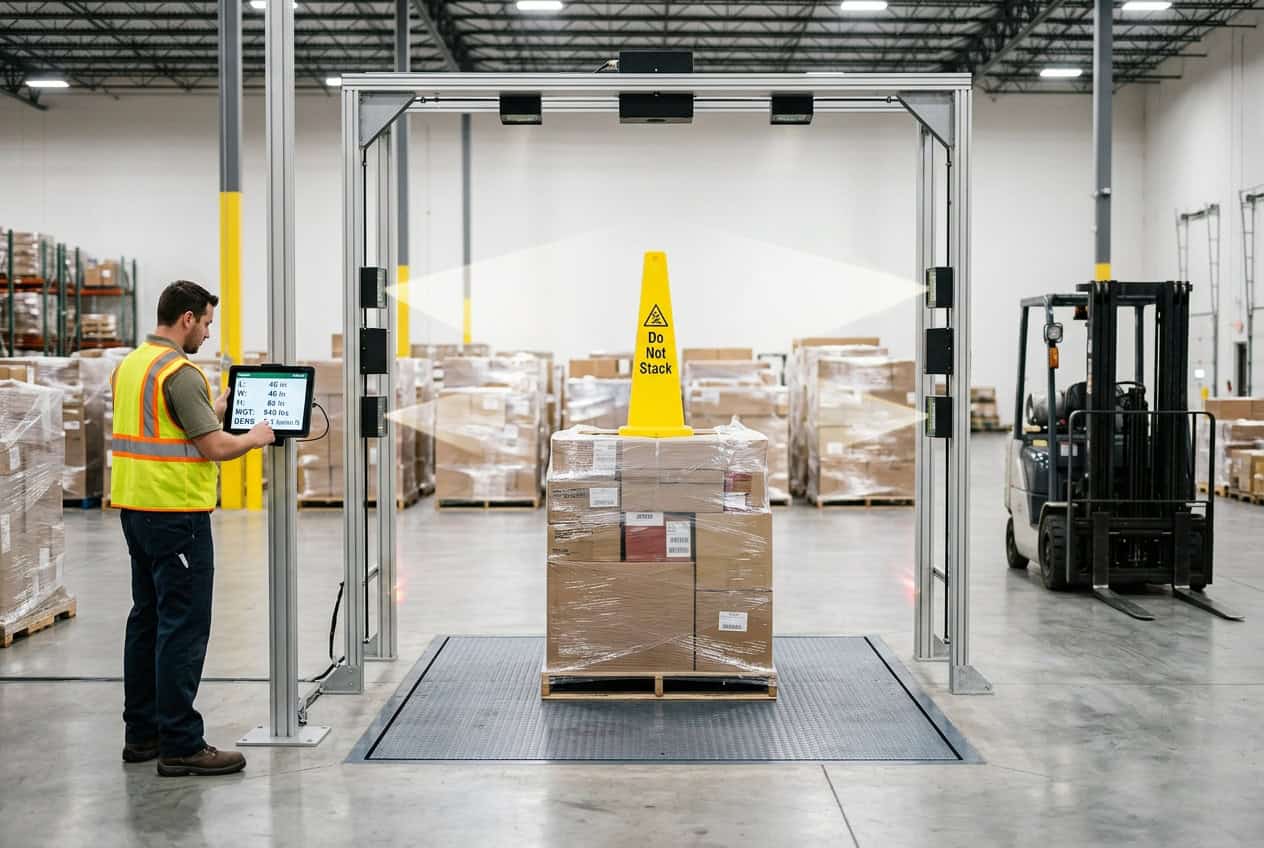
Measurements should reflect the greatest straight-line dimensions of the handling unit, including projections. In other words, measure the space the freight actually occupies—not simply the dimensions of the pallet or the product inside its packaging.
That includes freight tendered with a Do Not Stack cone or similar device. If the device is part of the handling unit as tendered and increases its extreme dimension, that additional space can affect the measurement used to determine cube and density.
The lesson is simple: don’t assume the dimensions. Measure the finished handling unit exactly as it will be tendered.

Get the BOL Right
Accurate physical measurements need to be matched by accurate documentation.
The bill of lading (BOL) should clearly identify what is being shipped and provide the information necessary to properly classify the freight. That means companies should know their commodity, the applicable NMFC item number, and the freight class when required.
Be especially careful with multiple handling units. NMFC guidance states that, unless otherwise provided, density is calculated for each handling unit. However, when shipping papers show only a total weight for all handling units tendered, density may be calculated using the total weight and total cube.
Good data capture therefore needs to extend all the way to the shipping documents. What appears on the BOL should accurately reflect what is sitting on the dock.
Don’t Forget Packaging Requirements
Classification isn’t only about density.
Minimum packaging requirements are specific to commodity descriptions and establish how articles must be packed or protected for shipment. Packaging can therefore be an important part of properly applying the NMFC.
Before tendering freight, make sure you have identified the correct NMFC item and reviewed any applicable minimum packaging requirements. A correct density calculation does not eliminate the need to comply with those provisions.
Packaging also deserves additional attention as companies evaluate their shipping profiles. How a product is packaged can change its dimensions, its density, and ultimately how efficiently it occupies space in an LTL trailer.
Remember: FAKs Are Separate from the NMFC
Another area that can create confusion is Freight All Kinds, or FAK, provisions.
FAKs are not addressed in the NMFC. They are separate commercial arrangements that should be discussed with your transportation provider.
Better Information Up Front Means Less Friction Later
Reducing reclasses and disputes doesn’t require a complicated strategy. It starts with getting the basics right.
Know what you are shipping. Determine the correct NMFC item. Meet the applicable packaging requirements. Weigh the handling unit accurately. Measure to its extreme dimensions as tendered. Calculate density correctly. And make sure the BOL accurately reflects the freight.
As classification becomes increasingly dependent on measurable shipment characteristics, those practices are becoming even more valuable.
Better data at origin gives shippers, carriers, and third-party logistics providers (3PLs) a common starting point. And when everyone is working from the same accurate information, there are fewer surprises, and fewer reasons for a reclass or dispute later in the process.