
Understanding the Fundamentals of the
National Motor Freight Classification
Every industry has its own language. In less-than-truckload (LTL) shipping, that language is the National Motor Freight Classification® (NMFC®) and its online iteration ClassIT+®. While experienced transportation professionals may navigate the NMFC with ease, it can feel overwhelming for someone just entering the industry. With so many commodity listings, rules, and notes to sort through, it’s not always obvious where to begin.
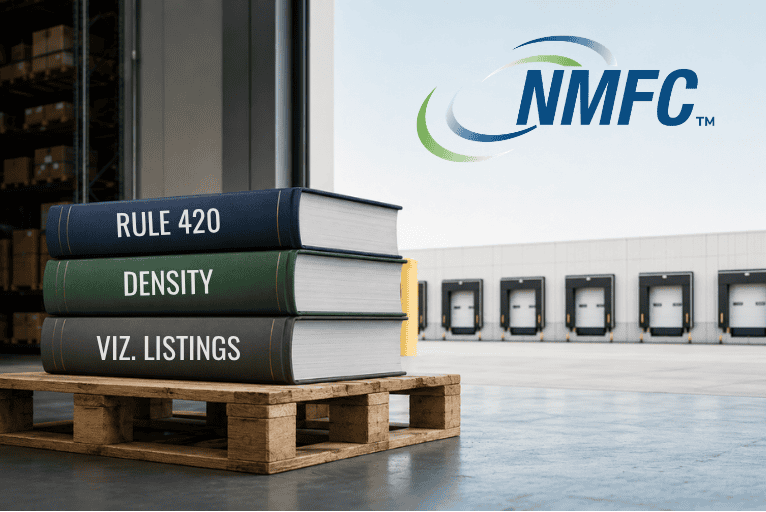
Consider this your syllabus. The good news is that understanding freight classification doesn’t require memorizing the entire NMFC. Once you understand a few foundational concepts, you’ll be able to classify freight more accurately and understand why the system works the way it does. The NMFC was designed to create consistency and fairness by evaluating commodities based on their transportation characteristics and providing a common language for carriers, shippers, and logistics providers. Recent modernization efforts have also focused on making the system simpler, more uniform, and easier to learn.
When classifying freight, the goal is to find the correct NMFC provision that applies on a commodity and to determine the class associated with that item. The class takes the form of the numbers 50 to 500 in the “CLASS” column that represent the relative “transportability” of a commodity. Think of the lessons below as your core curriculum—the fundamentals every newcomer needs before moving on to more advanced coursework.
Start with Rule 420
If there is one rule every classification professional should know, it’s Rule 420.
Particularly section 5, which states that a specific description takes precedence over a more general description, provided the article or material being classified is actually embraced within the terms of the specific description. It can be intimidating to search for a commodity and see a large number of items that could potentially apply, but if you remember that you’re looking for the most specific item that could apply to the commodity you’re trying to classify, you’ll be on the right track.
When searching for a product, don’t stop at the first word in its description. Read the entire item carefully and pay attention to notes, exceptions, and references to other provisions. The organization of the NMFC is designed to guide you to the correct classification—not just provide a list of products. Once you’ve got Rule 420 down, the next lesson is understanding how the NMFC is organized in the first place.
How Articles Are Organized
One of the biggest misconceptions about the NMFC is that it’s simply a giant alphabetical list of products.
In reality, articles are organized into commodity groupings that bring together similar products. Within those groupings, individual items describe the commodities, identify applicable provisions, and specify how they should be classified.
The classification contains many generic headings that cover broad categories of products. These headings help simplify the NMFC by grouping similar commodities that share common transportation characteristics. With that structure in mind, there’s one more organizational feature worth studying closely: Viz. listings.
Don’t Overlook “Viz.” Listings
Another feature that often surprises new users is the use of “Viz.” listings. “Viz.” is short for videlicet, a Latin term meaning “namely.” In the NMFC, a Viz. listing identifies specific products that are included under a broader commodity heading.
Think of it as a roadmap. Rather than creating separate items for every individual product, the NMFC may establish one general heading followed by a Viz. list of the products that belong there.
Learning to recognize Viz. listings helps users quickly determine whether their commodity falls within an existing item instead of searching for an entirely separate listing. It also reinforces one of the primary goals of today’s NMFC: simplifying commodity organization while maintaining clarity. From here, the coursework gets a bit more technical—it’s time to talk about density.
Understanding Density Breaks
Many NMFC items use a series of density ranges that correspond to different freight classes. Generally speaking, higher-density freight receives a lower freight class because it uses trailer space more efficiently and is less costly for carriers to transport. Lower-density freight typically receives a higher class because it occupies more trailer space relative to its weight.
One of the goals of the National Motor Freight Traffic Association, Inc.’s® (NMFTA™) Classification Reimagined initiative has been to standardize these density scales wherever density is the primary transportation characteristic. Rather than having numerous unique density tables throughout the NMFC, many commodities now follow a common density progression, making the system more predictable and easier to apply. This standardization helps reduce confusion while improving consistency across similar commodities.
The key takeaway for newcomers is simple: don’t assume the class based solely on the product. Always determine whether density is part of the item’s classification provisions before assigning a class.

Calculating Density
To calculate density:
- Measure the shipment’s greatest length, width, and height, including all projections.
- Calculate the cubic feet.
- Determine the shipment’s weight, in pounds.
- Divide the shipment’s weight by the cubic feet.
For example, if a pallet weighs 600 pounds and occupies 40 cubic feet, its density is 15 pounds per cubic foot (600 lbs ÷ 40 cu ft = 15 lbs/cu ft).
That single calculation can determine the freight class for many commodities, making accurate measurements critical. Even small errors in dimensions or weight can result in an incorrect class and create billing disputes later. Getting the class right is only half the lesson, though — packaging is the other half.
Minimum Packaging Requirements Matter
One mistake many newcomers make is focusing only on the freight class while overlooking the packaging requirements.
Every commodity listing should be reviewed for any applicable minimum packaging requirements. These provisions establish how an article should be prepared for transportation to ensure it can move safely through the LTL network.
Packaging requirements may specify whether an item should be boxed, crated, banded, palletized, or otherwise protected. In some cases, packaging can even influence how a shipment is classified because proper packaging affects handling, protection, and transportability.
Meeting the minimum packaging requirements not only helps ensure compliance with the NMFC but also reduces the likelihood of freight damage, reclassification, or unexpected charges. Even as commodity listings are consolidated and simplified, those packaging requirements remain an essential part of the applicable provisions.
Building a Strong Foundation
Consider this lesson complete—but like any good class, the real learning happens with practice. The easiest way to get started with the NMFC is through ClassIT+, the next generation, lightning-fast platform designed specifically for LTL carriers, shippers, and third-party logistics providers (3PLs).
Learning freight classification is much like learning a new language—it takes practice. Fortunately, every shipment provides another opportunity to become more comfortable with the NMFC.
These concepts won’t make someone an expert overnight, but they will provide a solid foundation for using the NMFC with confidence. As the classification system continues to evolve, understanding these basics will make it easier to adapt, classify freight accurately, and support a more efficient LTL industry. Consider yourself a lifelong student of the NMFC—there’s always another lesson to learn.