
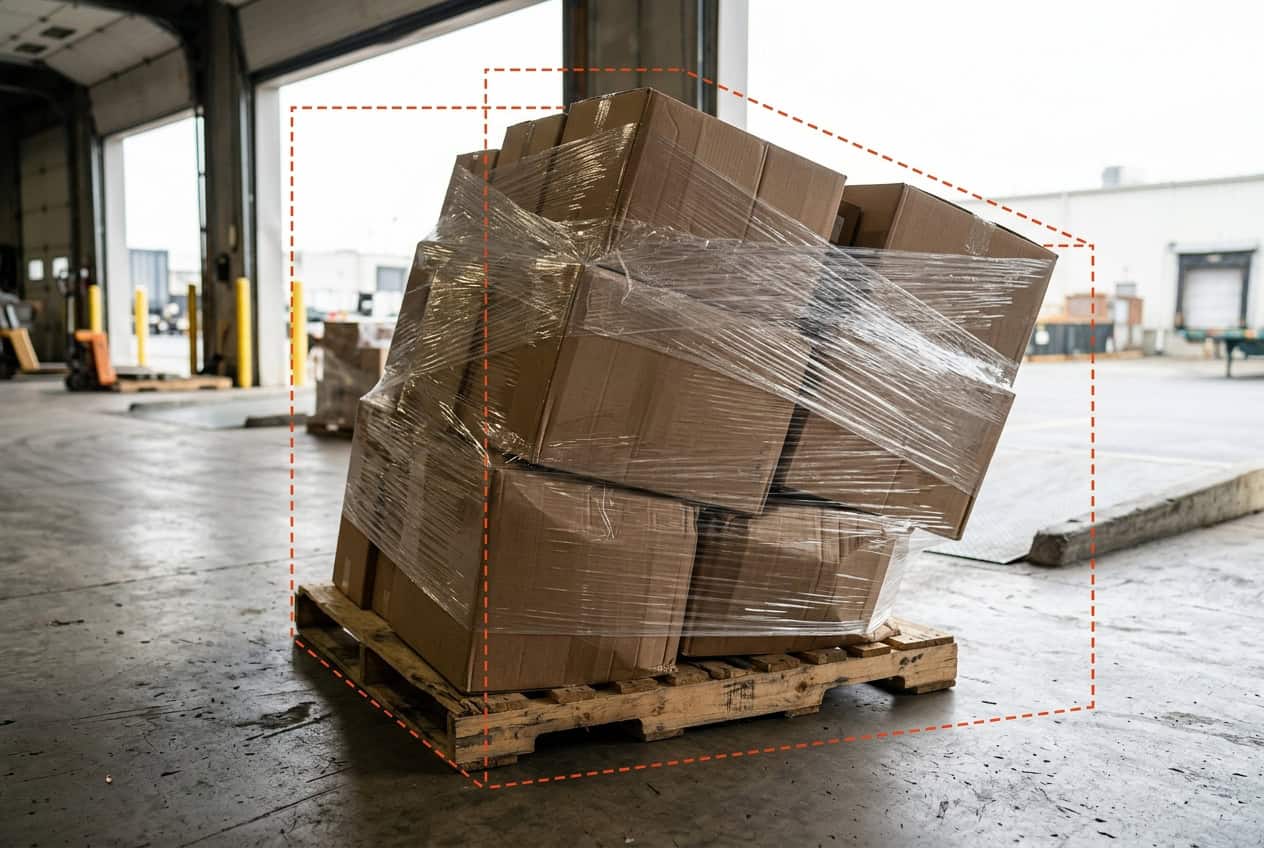
Dimensioners have become standard equipment on the less-than-truckload (LTL) dock. They measure quickly and consistently on the dock during transfers. That changes what load stability means for shippers. A pallet that leans or slides in transit no longer just risks damage. It risks a higher class, because the machine measures the shape that arrives.
With Docket 2025-1 moving thousands of National Motor Freight Classification® (NMFC®) items onto the Freight Classification Development Center (FCDC)’s 13-subprovision density scale, the measured shape of a handling unit now drives classification for a much larger share of LTL freight.
What a Dimensioner Sees
A dimensioner captures the smallest rectangular envelope that fully contains the handling unit, often called the bounding box. NIST Handbook 44, Section 5.58, which governs commercial multiple dimension measuring devices, describes them as generally used to measure hexahedron-shaped objects. The output is the length, width, and height of that bounding box.
That matches how the density-based provisions within the NMFC work, since density calculations require extreme dimensions. The pallet counts. Corner boards that stick above the load count. A “do not stack” cone counts. So does any part of the load that has moved outside its original footprint or bounding box.
The bounding box has no idea your load was built to 48 by 40. If the top of the stack has moved eight inches to one side, the reported width includes those eight inches of air.
Leaning: When the Top Moves Past the Base
When a stack tips, the pallet stays where it is and the upper layers travel sideways. The dimensioner has to capture both, so the reported width runs from one pallet edge out to the farthest point of the leaning stack. Reported height stays close to the original, since tipping a few degrees shortens the vertical only slightly. The taller the stack, the farther the top travels for the same amount of tip. On a 60-inch stack, a lean of about 10 degrees, roughly the tilt you would notice from across the dock, puts the top around 10 inches past the pallet edge.
Cube grows. Weight does not change. Density goes down.
| L x W x H | Weight | Cubic feet | Density | Class | |
| As built | 48 x 40 x 60 | 900 lb | 66.67 | 13.50 | 85 |
| As measured, leaning 10 degrees | 48 x 50 x 59 | 900 lb | 81.94 | 10.98 | 92.5 |
Nothing was added to the shipment. A film application that failed to hold the upper layers moved this handling unit up a full class sub provision.
Shifting: Strapped in One Direction Only
Now consider a single long box on a pallet, 88 inches long and 30 inches wide, secured with two straps running the width of the load. Those straps resist widthwise movement and leave lengthwise movement unchecked.
Shock and vibration in transit work the box lengthwise. It slides until 12 inches of the box hangs off the end of the pallet, unsupported by the top deck.
| L x W x H | Weight | Cubic feet | Density | Class | |
| As built | 96 x 40 x 26 | 370 lb. | 57.78 | 6.40 | 125 |
| As measured, shifted lengthwise | 108 x 40 x 26 | 370 lb. | 65.00 | 5.69 | 175 |
The box never left the pallet. It moved in the one direction that nothing was holding it, and the reported length grew to match. A unit load has to be stabilized in both horizontal directions, because securement along a single axis leaves the perpendicular axis open.
Unintentional Height
Some density loss gets built in at the dock before the load ever moves. “Do not stack” cones, top caps, oversized cartons filled with void fill, and corner boards that are taller than necessary all push the measured height up while the weight stays put.
The NMFC requires extreme dimensions, so the tip of the cone sets the height, and the dimensioner reads it that way every time.
| L x W x H | Weight | Cubic feet | Density | Class | |
| Load as stacked | 48 x 40 x 60 | 900 lb. | 66.67 | 13.50 | 85 |
| Same load with 8-inch cones | 48 x 40 x 68 | 900 lb. | 75.56 | 11.91 | 92.5 |
A cone communicates to the carrier that the handling unit should not be top loaded. It carries no weight and protects nothing on its own, so the height it adds is height spent on a message. Worth sending when the freight needs it, worth measuring and declaring when you do.

Where That Leaves You
Four things hold density where you built it.
First, get your stretch film and your wrapper in order. Buy at least a mid-grade film with a cling additive, commonly called a tackifier, since cling is what keeps each layer holding the one beneath it all the way to destination. Check that the pre-stretch rollers are clean and unworn, and confirm the machine is delivering the stretch it claims. Then verify the result rather than the settings. ASTM D4649 gives you the pull plate method, which tells you what containment force is actually on the load. Finally, carry two or three revolutions onto the top of the pallet. Loads wrapped only to the boxes are the ones that walk under shock and vibration, which is the failure in the shifting example above.
Learn More: How to Palletize a Shipment.
Second, strap in both horizontal directions (also called banding). Use at least two straps each way, because a load will move along whatever axis you leave open. Run them under the stringer between the bottom deck boards, so they clear the fork notches and stay off the floor. For target strapping break strength, multiply the load weight by 1.5 and divide by the number of straps.
Third, chock anything that may roll or slide. Placement is what makes it work: set the block against the freight, hold it there, then fasten it with at least two fasteners. A block nailed an inch off gives the freight room to accelerate into it, and that gap is enough to shear the fastener.
And finally, look hard at height you are adding without meaning to, from cones and top caps to cartons taller than the product inside them.
The dimensioner reports what it finds and nothing else. Build the handling unit so the shape it finds is the shape you shipped.
For other helpful tips, visit NMFTA’s LTL Packaging page below.
Related Reading: Packaging and Class: How Packaging Decisions Change Density and Your Invoice.