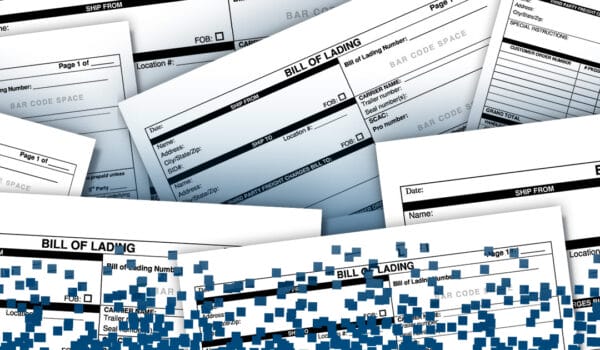
A Bill of Lading (BOL) is supposed to be a trusted, controlling document—the paper (or digital record) that tells everyone what’s moving, who’s hauling it, and where it’s going. That’s exactly why fraudsters target it.
If a bad actor can alter or forge a BOL (or show up with one that looks legitimate), they may be able to:
- Pick up freight they’re not authorized to haul;
- Redirect a shipment to a different destination;
- Disguise high-value cargo; and/or
- Create billing and claims chaos that’s hard to unwind after the trailer leaves the yard.
As a general rule: the earlier you catch BOL anomalies, the more likely you are to prevent a theft or a costly dispute. National Motor Freight Traffic Association, Inc.® (NMFTA)™ Freight Fraud Prevention Hub is built for that early-warning mindset—helping the industry recognize patterns, share signals, and operationalize repeatable prevention practices.
Many freight processes still rely on manual handling (PDFs, email attachments, screenshots, rekeying details). Any time shipment data moves between systems without shared standards or verification, fraud has room to operate. NMFTA highlights this broader problem: fraud thrives when systems don’t communicate consistently—creating gaps where manipulation and missed signals are more likely.
Also, regulators continue to warn the industry about broker/carrier identity theft—where scammers use a legitimate carrier’s identifiers (like a USDOT number) without authorization, or operate as an unregistered broker, according to the Federal Motor Carrier Safety Administration (FMCSA).
Below are the most frequent ways fraud shows up on BOLs in trucking and logistics. You’ll notice a theme: the BOL is used to make an unauthorized pickup or delivery look legitimate.
1) “Carrier identity swap” on the BOL
What it looks like:
- The BOL lists a carrier name that doesn’t match who was tendered the load.
- The driver shows up under one company name, but the paperwork reflects another.
- The BOL includes a real USDOT/MC number—but it belongs to a different company.
Why it matters: This is a common ingredient in fraud and identity theft schemes involving carriers/brokers. FMCSA specifically calls out identity misuse (e.g., using another motor carrier’s USDOT number without authorization).
Example scenario:
A shipper tenders a load to “ABC Logistics.” A truck arrives branded “XYZ Transport.” The driver presents a BOL where the carrier name has been edited to match the tender… but the phone number on the BOL routes to the scammer, not the legitimate carrier.
2) Consignee or delivery address alteration (redirect theft)
What it looks like:
- Destination address is different from the shipper’s tender/TMS/rate confirmation.
- “Care of” (c/o) or an unfamiliar warehouse is added late.
- Contact name/phone at delivery is swapped to a personal cell number.
Why it matters: Cargo theft experts and claims professionals warn that doctored paperwork can be used to take loads that don’t belong to the driver presenting the documents—especially if the shipper doesn’t validate BOL integrity before releasing freight.
Example scenario:
The original destination is a known DC. The BOL presented at pickup shows a different address “due to receiving issues,” with a new appointment contact. Freight leaves the facility and is never seen again.
3) Duplicate / cloned BOLs
What it looks like:
- Two “original-looking” BOLs exist for the same shipment ID;
- A BOL appears in circulation that your team didn’t issue; and/or
- Same PRO/shipment number, but different details (pieces, weight, consignee, dates).
Why it matters: Fraud analysts note that fraudsters may duplicate legitimate-looking BOLs or alter real ones using common PDF editing tools.
Example scenario:
A fraudster obtains a real BOL template used by your facility, recreates it, and uses it to attempt a pickup before the legitimate carrier arrives.
4) Forged signatures, stamps, seal numbers, or “too-perfect” documents
What it looks like:
- Signature blocks are suspiciously uniform (identical “handwritten” marks across documents).
- Seal numbers are missing, overwritten, or don’t match what’s recorded in the yard.
- The BOL looks like it’s been assembled (mixed fonts, misaligned fields, odd spacing).
Example scenario:
A driver presents a BOL that includes a seal number—yet the trailer is unsealed. Or the seal number on the BOL doesn’t match the seal applied at the dock.
5) Commodity / quantity / weight manipulation (often tied to billing or theft risk)
What it looks like:
- Commodity description is unusually vague (“general merchandise”) for high-value freight.
- Weight and pieces don’t match warehouse paperwork.
- NMFC / class is missing or inconsistent for LTL moves.
Why it matters: NMFTA emphasizes that inaccurate or manipulated freight classification data can conceal risk (including high-value/high-risk freight) and create downstream disputes and exposure.
Example scenario:
A shipment of high-value electronics is described as “parts” with understated weight and incomplete detail—making it easier to target and harder to recover.
A practical “Spot It” checklist: what to verify on every BOL
Use this as a repeatable, front-line checklist at pickup and before delivery.
Step 1: Match the BOL to the tender (no exceptions)
Cross-check these fields against your TMS / tender / rate confirmation:
- Shipper + pickup location
- Consignee + delivery address
- Shipment/PRO number
- Commodity description + special handling notes
- Pieces, pallet count, weight
- Required appointments and reference numbers
If anything differs, stop and escalate before releasing freight.
Step 2: Validate the carrier identity (beyond what’s printed on the BOL)
At minimum:
- Verify carrier/broker contact info using authoritative sources (FMCSA SAFER is a common baseline) and call the number listed there, not the number on the BOL.
- Watch for “pressure to move fast” and requests to “present yourself as a different carrier name”—FMCSA flags these as reasons to stop a transaction.
Step 3: Look for document tampering signals
Red flags include:
- Different fonts in key fields (carrier, consignee, address, weight);
- Cropped logos, blurry text, uneven margins;
- “Updated” dates or destinations with no audit trail; and/or
- Signature images pasted in (instead of live capture).
(These are consistent with how fraud analysts describe altered/forged BOL creation—often by editing real documents or using templates.)
Step 4: Verify physical reality against paperwork
At pickup:
- Confirm driver ID, tractor/trailer identifiers, and seal numbers match recorded details.
- Require facility staff to record tractor/trailer plate info and compare it to what was tendered—FMCSA encourages maintaining these logs to help identify the actual carrier involved.
How to prevent BOL fraud
NMFTA’s fraud prevention guidance emphasizes that prevention isn’t one magic step—it’s a layered approach with repeatable operational controls and early detection.
Here’s what “layered” looks like for BOL integrity:
1) Tighten release controls at the dock
- No pickup without: verified carrier identity, verified driver, matched references, and documented equipment info.
- Treat late-stage changes (destination, consignee, “re-consign”) as high risk and require secondary approval.
2) Reduce manual document handling
Manual rekeying, emailed PDFs, and screenshots create easy opportunities for alteration. NMFTA’s DSDC API standards are designed to modernize freight data exchange and create more consistent, trusted digital signals—reducing fragmentation and manipulation opportunities.
Practical move: shift toward electronic BOL workflows where changes are logged and traceable.
3) Make classification integrity part of fraud prevention
Especially in LTL, misclassification can be “just an error,” but persistent inconsistencies can signal manipulation. NMFTA highlights that classification accuracy reduces ambiguity that fraudsters exploit and supports better risk assessment.
4) Train teams on the top BOL fraud patterns
Train dock, dispatch, and customer service teams to recognize:
- carrier identity swaps;
- destination changes;
- duplicate BOLs;
- vague commodity descriptions; and/or
- urgency and “skip verification” tactics.
5) Use the NMFTA Freight Fraud Portal to share and learn patterns
Fraud doesn’t stay isolated to one company. The Freight Fraud Prevention Hub supports industry awareness and practical education so teams can recognize emerging tactics sooner and strengthen response playbooks.
A BOL is only as trustworthy as the verification process wrapped around it.
If your team does just two things consistently, you’ll eliminate a large percentage of BOL-based fraud attempts:
- Match the BOL to the tender/system-of-record every time, and
- Verify the carrier identity using trusted channels (not the paperwork itself).