For decades, the Standard Carrier Alpha Code® (SCAC)™ has been the freight industry’s universal identifier. If you move freight, your SCAC follows you across brokers, shippers, platforms, and borders.
But while freight has become increasingly digital, freight fraud has evolved right alongside it.
Today’s most common fraud schemes, impersonation, double brokering, and fictitious pickups, don’t succeed because systems are broken. They succeed because identity assumptions go unchecked across disconnected workflows. That reality is what led the National Motor Freight Traffic Association, Inc.® (NMFTA)™ to make an important change—one that officially goes live today.
SCAC Verified Is Now Live
Today, NMFTA is launching SCAC Verified™, the next evolution of the SCAC lookup tool formerly known as SCAC Online. SCAC Verified makes it easier for the industry to check SCAC status using a tool everyone already recognizes, now with clearer trust signals behind it.
At the same time, a new ID verification requirement for non-Class 8 carriers takes effect during SCAC application and renewal. Together, these changes represent a shift in how the industry approaches freight fraud, not reactively, after a loss occurs, but proactively, before freight ever moves.
[insert product screenshot of SCAC Verified lookup interface showing a SCAC search result with status (e.g., active/expired), and verification shields for both C8 and NC8]
What Changed, and What Didn’t
For non-Class 8 carriers, the change is straightforward. Identity verification is now required when applying for or renewing a SCAC. This step confirms that a real, verified individual is associated with the SCAC. We are also completing address verification of the SCAC holder to ensure validity and to ensure the address is not a rental unit, empty warehouse, or a P.O. box.
What has not changed is just as important. Class 8 carriers continue to be verified through Federal Motor Carrier Safety Administration (FMCSA) data . SCAC remains the industry’s mandatory carrier identifier. And this new requirement does not evaluate operations, safety performance, or authority. It verifies identity, nothing more.
View the SCAC ID verification overview for Non-Class 8 carriers here.
Why NMFTA Introduced Identity Verification for SCAC
Freight fraud today is rarely opportunistic. It is organized, repeatable, and increasingly dependent on identity misuse. NMFTA believes ID verification will add another level of traceability in the fight against drug and human trafficking.
Bad actors succeed by impersonating legitimate carriers, reusing stolen credentials, and exploiting the gaps between onboarding systems. Once a fraudulent identity is accepted in one place, it can move through others with little resistance.
Rather than layering on more downstream checks, NMFTA focused upstream—on the operating environment where fraud begins. SCAC is already universal across the industry, so by binding verified identity to the SCAC at application and renewal, we raise the barrier against impersonation before freight is tendered, dispatched, or picked up.
Explore NMFTA’s approach to freight fraud prevention here.
How SCAC Verified Works as a Shared Trust Signal
SCAC Verified is the public-facing expression of this shift.
It gives brokers, shippers, platforms, and partners a simple, consistent way to check SCAC status and understand whether a code is active or expired. It also provides a shared trust signal at key moments such as onboarding, tendering, and pickup.
Importantly, SCAC Verified is designed to be status-only. It does not display personal information or sensitive data. Its purpose is not to score carriers or predict outcomes—it is to enable clearer, earlier decisions across the freight ecosystem.
[add product screenshot showing close-up of the SCAC status result, green vs red color, shield with person vs shield with noperson (status-only view, no personal info)]
Learn how to check a SCAC using SCAC Verified here.
What Identity Verification Actually Means
For non-Class 8 carriers, identity verification is completed through a third-party partner. The process confirms that a real person is tied to the SCAC and helps prevent impersonation or misuse of legitimate carrier identities. It is designed to be completed at application and renewal.
Just as important, identity verification is not a background check, a safety certification, or a guarantee of performance. It does not judge how a carrier operates. Its sole purpose is to establish identity assurance at the point where trust first enters the system.
As always, NMFTA offers support if issues arise and to answer your questions.
Explore how SCAC ID verification works here.
How SCAC Verified Helps Protect Legitimate Carriers
Freight fraud doesn’t only harm shippers and brokers. It also harms carriers whose identities are stolen, reused, or misrepresented.
By verifying identity at the SCAC level and making status easier to check, the industry reduces the likelihood that legitimate carrier identities are impersonated. It becomes easier to distinguish real operators from fraudulent lookalikes and to prevent issues before they disrupt operations.
For small and mid-sized carriers in particular, this change is about protection, not paperwork.
What SCAC Verified Means Across the Freight Ecosystem
While today’s identity verification requirement applies specifically to non-Class 8 carriers, SCAC Verified was built for the entire freight industry. Every participant touches SCAC at different moments, and those moments are exactly where fraud risk concentrates.
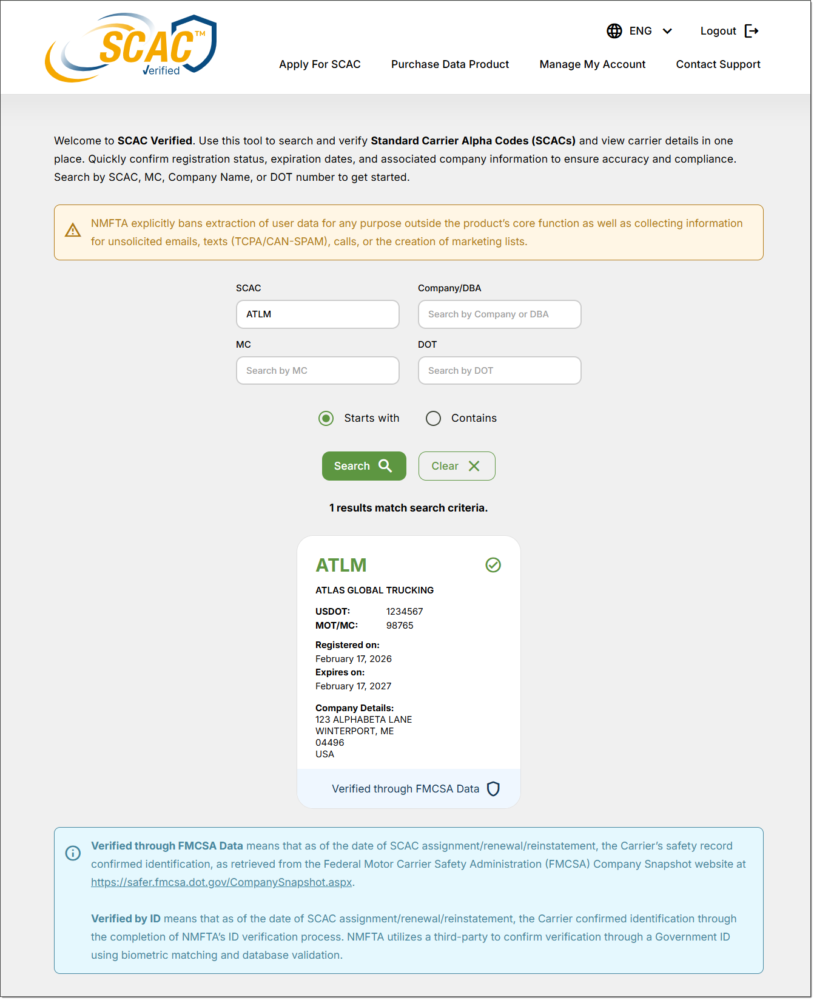
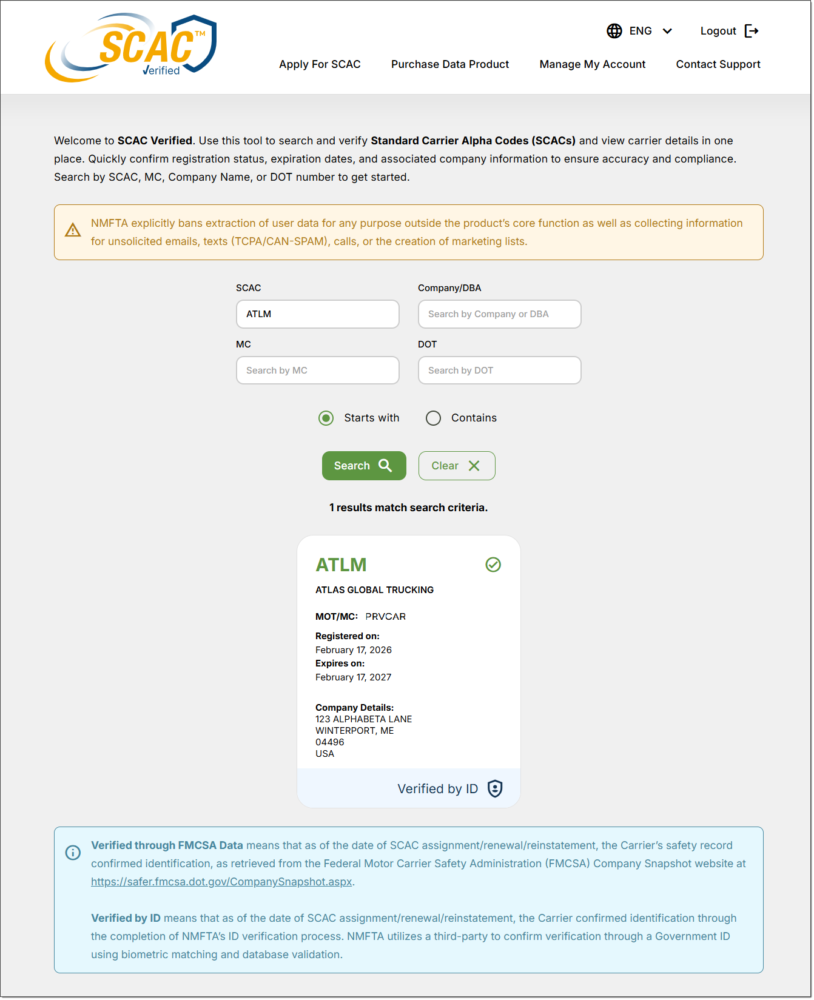
Pictured above and below: Verification banners on tiles for both ID verification and FMCSA Data are visible.
For Class 8 Carriers
Nothing about your SCAC application or renewal process is changing today. Verification continues through FMCSA credentials.
What is changing is the environment around you. As SCAC Verified becomes more widely used across onboarding, tendering, and lookup workflows, verified identity signals help protect legitimate carriers from impersonation and fraudulent reuse of their credentials.
A Class 8 Carrier’s FMCSA verification status is also displayed in SCAC Verified, making it an easy way to check if a Class 8 carrier’s identity has been verified using FMCSA details.
Check your SCAC status using SCAC Verified here.
For Shippers
SCAC Verified provides a simpler, more consistent way to confirm carrier identity at onboarding and tender—without introducing new vendor tools or exposing sensitive information.
Instead of relying on fragmented checks across systems, shippers can use a shared, industry-recognized signal to reduce the risk of fictitious pickups and identity-based fraud before freight moves.
Learn how to use SCAC Verified during carrier onboarding here.
For Brokers and 3PLs
Brokers and 3PLs sit at the center of carrier onboarding, and that’s where identity misuse most often enters the system.
SCAC Verified offers a fast, status-only way to validate SCACs using a credential your teams already recognize. Over time, this supports cleaner onboarding, fewer exceptions, and reduced exposure to impersonation schemes.
See how SCAC Verified supports safer carrier onboarding here.
For Platforms and Load Boards
Fraud scales when platforms can’t distinguish between legitimate and impersonated identities.
SCAC Verified creates an opportunity to integrate a neutral, industry-backed trust signal into search, onboarding, and filtering experiences—raising the baseline level of trust without introducing privacy risk.
Explore SCAC Verified integration opportunities here.
For Technology Providers
Carrier identity is a shared dependency across transportation systems.
SCAC Verified offers a standardized reference point for identity assurance that can complement existing workflows, reduce ambiguity, and help align systems around a common trust signal.
Learn how SCAC Verified fits into the freight technology ecosystem here.
What Non-Class 8 Carriers Should Do Next
If you are a Non-Class 8 carrier, the next step is simple. Use SCAC Verified to understand your SCAC status, complete identity verification when prompted at application or renewal, and take advantage of NMFTA resources if questions arise along the way.
Get started with SCAC Verified today.
Learn more about ID Verification requirements for non-Class 8 Carriers here.
The trucking industry runs on trust. With SCAC Verified, that trust is no longer assumed; it is verified.
Trust the Code.