
This is Part 1 of a three-part series on summer packaging hazards in the LTL environment.
Summer brings longer days, higher temperatures, and depending on your service lanes in North America, a level of humidity that most shippers underestimate as a threat to their freight. Packaging that sailed through February can quietly degrade, warp, or collapse by July, and when it does, the result is damaged goods, freight claims, and customer complaints.
Of all the packaging materials affected by summer conditions, none is more consequential to get right than corrugated fiberboard. It is everywhere in the supply chain, and summer is the season that exposes its core weakness. Understanding why corrugated fails in summer, and what shippers and carriers can do to manage it, is the great starting point for any seasonal packaging review.
How Humidity Erodes Corrugated Board Strength
Corrugated fiberboard is the most widely used shipping container in the country, and for good reason, when properly specified and handled, it performs reliably across a wide range of conditions. Summer, however, is the season that exposes a core vulnerability. As ambient relative humidity increases past 95%, the stacking strength of a corrugated box can decrease by more than 60%. That figure comes from industry research compiled in the Fibre Box Handbook published by the Fibre Box Association.
The mechanism is straightforward. Corrugated fiberboard is a paper-based product, and paper fibers absorb moisture from the surrounding air. As the fibers soften and the starch-based adhesives weaken, the box walls and flutes lose the rigidity that gives them their compressive strength. The corners, which bear roughly two-thirds of a box’s total compression load, become especially vulnerable. A box that met its rated weight limit when it was manufactured may fail well below that threshold after sitting in a humid warehouse or on a dock during a summer rainstorm. The failure may not be immediately visible. Humidity weakens corrugated gradually and silently, and by the time a box shows visible distress, the structural damage is already done.

Liquid Water: A More Immediate Threat
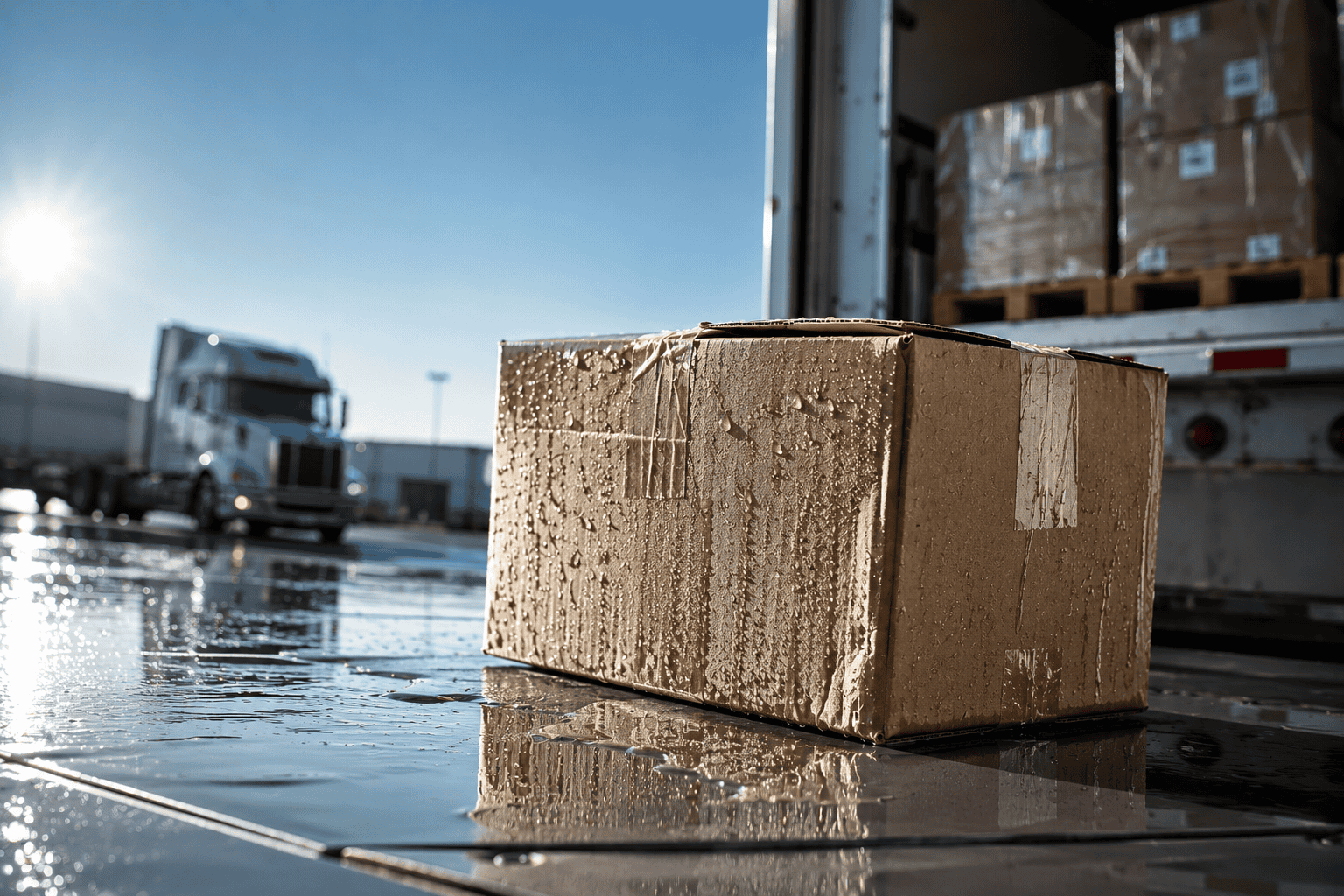
Humidity weakens corrugated packaging gradually, but liquid water destroys it almost immediately. Summer creates many ideal conditions for corrugated to be exposed to liquid water. Condensation forms on trailer walls, floors, and dock when warm humid outside (often morning) air meets a cooler surface. Dock transfers expose freight to open air during a season when afternoon thunderstorms arrive with little warning. Whether the source is condensation, dock puddles, or a brief encounter with summer rain, the result is the same: paper-based packaging loses more than 90% of its strength on contact.
Paper-Based Pallets and Dunnage
Paper-based pallets, including paperboard, corrugated, and honeycomb paper varieties, are at an even greater disadvantage during humid summer months. Sitting closer to the trailer floor, they are more likely to be exposed to pooling condensation, which can destroy their structural integrity almost instantly. Paper pallets that perform marginally in dry conditions are pushed past their limits when summer humidity enters the picture, making collapse under freight weight or normal fork handling significantly more likely.
Carriers often use corrugated and paper-based dunnage, honeycomb fiberboard, layered corrugate, and similar products, to fill voids and stabilize loads inside trailers. These materials face the same humidity vulnerability as corrugated boxes. Their structural effectiveness depends on maintaining fiber rigidity, and summer humidity reduces that rigidity in the same way it degrades box stacking strength. Shippers relying on paper-based blocking and bracing should be aware that dunnage performing adequately in dry climates may perform significantly worse in humid environments.
What Shippers and Carriers Can Do
The starting point is storage. Corrugated packaging and dunnage that sits in an unconditioned warehouse or on an open dock before it is ready to be used is already absorbing humidity and losing strength. Storing corrugated materials in climate-controlled areas prior to use preserves the rated performance of the corrugated board.
Beyond storage, the more consequential decision is board specification. Packaging engineers operating in uncontrolled summer conditions should map their supply chain and identify the worst-case humidity exposure their freight will realistically encounter. A shipment moving through the Gulf Coast in August is a fundamentally different humidity environment than the same shipment moving through the same lane in October. Once the exposure profile is understood, the cost-benefit analysis becomes more straightforward. Upgrading to a heavier board grade carries a predictable cost. The freight claims, customer complaints, and operational disruption that come with a lighter specification failing under summer conditions are considerably harder to calculate. Whether that cost is acceptable ultimately depends on what damage rate each shipper has defined as tolerable for their operation.
The tools to help point the packaging engineer in the right direction already exist. National Motor Freight Classification® (NMFC)® Item 222 provides tables defining minimum bursting test and edge crush test requirements by box weight and dimension. The Box Manufacturer’s Certificate stamped on every corrugated container confirms whether that box meets those minimums for the gross weight it will carry. Using both together, the NMFC tables to set the floor and the BMC to verify the box meets it, is the baseline practice for any packaging program that expects to perform consistently through the summer months.
None of these risks can be eliminated outright, but they can be properly mitigated. What separates shippers and carriers who manage seasonal swings successfully from those who don’t is awareness of these conditions and the standard operating procedures put in place to address them before a load is ever tendered.
Resources like the NMFC packaging testing standards and registered packaging labs exist to help shippers build requirements and specifications that hold up across seasonal conditions, not just average ones. If your organization is evaluating packaging specifications for seasonal performance, or looking to understand where your current program may be vulnerable, contact us. We work with shippers and carriers across the country to build packaging programs that account for the conditions freight actually faces, including the ones that only show up in summer.
For other helpful tips, visit NMFTA’s LTL Packaging page and resources here: https://nmfta.org/standards/interpretations/packaging/