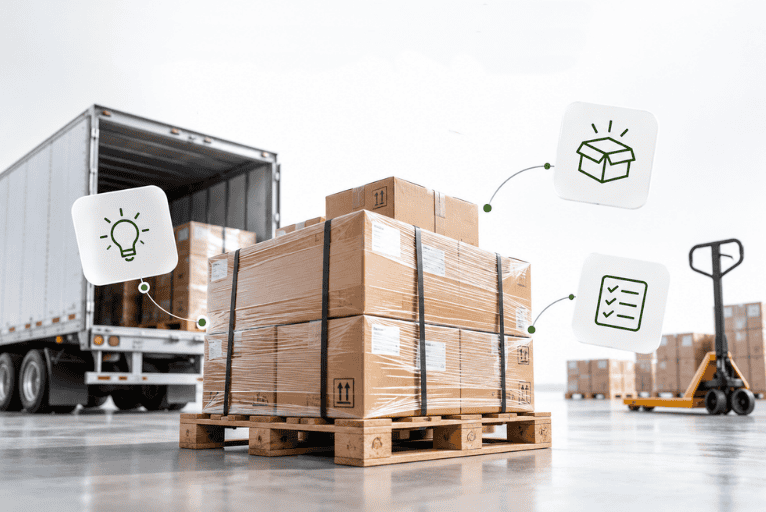
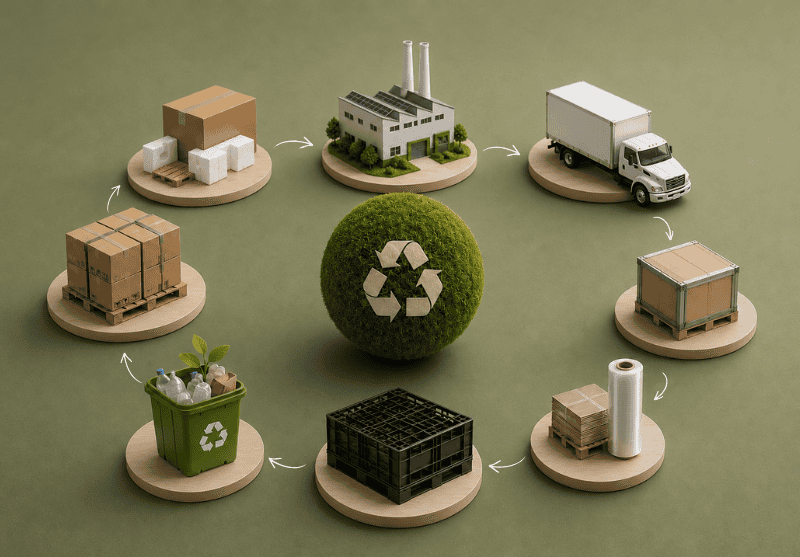
Extended Producer Responsibility (EPR) packaging laws are an operational reality for the freight industry. With five states now running active programs and at least five more expected to follow before 2030, EPR mandates are beginning to alter the packaging materials chosen, the design elements implemented, and some freight profiles in the emerging markets.
For less-than-truckload (LTL) carriers, the implications are both direct and indirect. Some effects are already visible in shipper behavior and packaging choices. Others will emerge gradually as EPR infrastructure matures and enforcement tightens. This post examines four areas where LTL operations are most likely to feel the impact.
What Is EPR?
Extended Producer Responsibility is a state-level policy framework that shifts the cost of a product’s packaging waste management, including collection, sorting, recycling, and disposal, from municipalities and taxpayers onto the parties that put the packaging into commerce. In most frameworks, the company that applies packaging to products is defined as the “producer,” which is typically the brand owner or importer whose name appears on the product.
EPR fee and reporting obligations apply across all levels of packaging. Primary packaging in direct contact with the product, secondary packaging that consolidates or protects multiple units, and tertiary packaging including corrugated boxes, crates, and pallets introduced into commerce are all potentially subject to producer fees depending on the jurisdiction.
The mechanism is straightforward. Producers are legally required to register with a designated Producer Responsibility Organization (PRO). Most active states use the Circular Action Alliance (CAA) in this role. Producers then report the total weight and material type of all packaging they distribute into the state annually and pay fees based on that tonnage. Fee rates are tiered by material. Recyclable materials carry lower fees; non-recyclable or hard-to-recycle materials carry higher ones. The intent is to make the cost of packaging reflect its end-of-life burden and to fund the infrastructure needed to manage it.
Non-compliance carries financial consequences. Producers that fail to register with the designated PRO, submit required annual reports, or remit fees by state-mandated deadlines are subject to civil penalties. Penalty structures are typically driven by the environmental compliance provisions of state law, which tend to carry significant enforcement authority. Consequences generally include per-day fines for ongoing violations, and some states reserve the right to pursue injunctive relief against producers who remain out of compliance after notification.
There is no federal EPR law. Every program is state-enacted, state-administered, and independently structured. Oregon was first, followed by Colorado, California, Maine, and Minnesota. The programs share broad architectural similarities, including producer registration, annual reporting, and PRO-administered fee collection, but differ in material definitions, fee schedules, exemption thresholds, and enforcement timelines. At least five additional states are expected to adopt programs before 2030, creating a growing patchwork of obligations for any shipper or carrier operating across state lines.
EPR is not a new concept internationally. Canada and the European Union have operated mature EPR frameworks for more than two decades. In Canada, provincial programs have been in place since the early 2000s, with producers managing packaging waste through industry-funded stewardship organizations. The EU’s packaging directive, first established in 1994 and significantly strengthened in recent years, sets mandatory recycling targets and places full financial responsibility for packaging recovery on producers. The United States (U.S.) is following a similar structural path, but on a state-by-state basis rather than through a unified federal mandate.
For the freight industry, EPR is relevant because it directly regulates packaging, and packaging is the interface between the product and the carrier. When EPR changes what shippers put freight in, it changes what carriers are handling and how it performs in transit.
1. Carrier Reporting & Fee Liability
Most EPR conversations focus on shippers and brand owners, the parties most commonly defined as “producers” under state frameworks. The producer definition, however, extends to any party that introduces packaging into commerce. Carriers and third-party logistics providers (3PLs) that offer add-on packaging, repackaging, or bundling services at the terminal or warehouse level are subject to the same registration, reporting, and fee obligations as any other brand owner.
Two practical examples illustrate how broadly this definition can apply. An e-commerce retailer that places a product into an additional corrugated over-box before shipment has introduced tertiary packaging into commerce and will owe fees on the weight of that corrugated material in every EPR-active state where those packages are delivered. Similarly, a 3PL that consolidates multiple shipments onto a pallet and wraps them in stretch film has introduced both the pallet and the film into commerce. In jurisdictions where those materials are shipped into and covered (not all states), the 3PL will owe fees on the weight of the stretch film and pallet. In both cases, the EPR obligation is limited to the packaging each party applied. The e-commerce retailer and the 3PL are not responsible for any packaging they did not add.
Once producer status is established, the compliance obligation is immediate and ongoing. Carriers and 3PLs must register with the designated PRO, report the total weight and material type of all packaging introduced into each EPR-active state annually, and remit fees based on that tonnage.
This creates a structural visibility problem for many carriers. Terminal packaging services are frequently managed and priced at the local service center level, absorbed into operating costs rather than tracked as a distinct line item at the corporate level. That decentralization makes it difficult to aggregate the data EPR reporting requires. A carrier with terminals in Utah and Texas, for example, is only liable for EPR fees on the packaging those terminals introduced into Oregon specifically, not their total packaging volume. Accurately capturing that state-level exposure requires a level of cost and activity tracking that most terminal operations are not currently set up to provide.
The administrative burden is real and may not be priced into most service agreements. Carriers offering terminal packaging services should audit those offerings against the producer definitions in Oregon, Colorado, California, Maine, and Minnesota before that review is triggered by an audit or fee assessment.
2. When Greener Packaging Creates Carrier Risk
EPR fee structures are designed to make non-recyclable materials or hard to handle materials expensive. They are working. Fees for Expanded PolyStyrene (EPS), (think coffee cup or cheap picnic cooler foam), in active jurisdictions can run up to 10x higher than those for paper-based alternatives, and shippers are responding accordingly. The packaging industry is in the process of broad material substitution away from foam cushioning toward paper-based systems to offset these fees.
For LTL carriers, foam and paper perform differently in transit, and the gap matters at the product protection level. There are two categories of risks emerging:
Loss of resilience. Foam has excellent cyclical rebound memory. It absorbs a wide range of impacts and returns to shape, ready to absorb the next one. Paper-based cushioning systems perform differently. Under large shock events or recurring vibration exposure, paper can compress and bottom out over the life of a shipment, leaving product progressively less protected as the freight moves through the network.
Moisture vulnerability. Paper’s structural rigidity and cushioning performance are highly susceptible to moisture. Humidity differentials on the dock and during transit, amplified by seasonal variation, can degrade paper’s structural integrity before a shipment reaches its first transfer point. Compromised structure and cushioning means compromised load security, and compromised load security means carrier liability exposure.
3. Reusable Packaging and Carrier Impact
EPR frameworks are not uniformly punitive. Most programs offer significant fee reductions, or full exemptions, for shippers who implement certified returnable or reusable packaging programs. For shippers moving volumes of the same commodity on regular lanes, the economics of reusable containers can be compelling. For LTL carriers, the shift toward reusable packaging produces three potential operational effects:
Reduced damage rates. Reusable containers are purpose-built for repeated transit cycles. They are structurally more robust than single-use alternatives, and damage rates on properly loaded reusable container shipments tend to be lower.
Increased billable poundage. A reusable plastic container is significantly heavier than a corrugated box carrying the same product. As reusable packaging penetrates the market, carriers should expect to see density and poundage per shipment increase on affected commodity lanes.
Return shipment volume. Reusable containers have to come back. A shipper running a reusable container program generates return freight that did not previously exist. Depending on the lane and volume, this could represent a meaningful source of incremental LTL business.
4. Bundled Loads & Small Business Volume
EPR programs are funded by producer fees, and those fees are earmarked for a specific purpose: building out state-level waste collection, sorting, and material consolidation infrastructure. That infrastructure build-out has freight implications that are easy to overlook in a discussion focused on packaging materials. Neither of these effects will reshape LTL volume. But both are real, directional, and tied to policy mechanisms that are now funded and operational.
Two downstream volume effects are worth monitoring:
Baled material growth. As EPR-funded collection infrastructure matures, the volume of consolidated, baled recyclable materials moving out of collection locations and toward processing facilities will increase. The growth trajectory here is tied directly to EPR program maturity. States with older programs will generate this volume sooner, but the trend is directionally consistent across all active jurisdictions.
Small business stimulus. EPR revenue is not solely directed toward infrastructure. State programs include significant grant funding for new business formation and product development at existing producers, both focused on creating goods from consolidated recycled materials.
The Bottom Line
EPR is a legally mandated waste management policy, but its freight implications are structural and will compound as more states adopt programs and enforcement matures. Carriers that treat EPR as a shipper problem are likely to find themselves absorbing costs and liabilities that were never anticipated in their service agreements or operating models. The carriers best positioned to navigate this shift will be those that get ahead of it: auditing terminal packaging services for producer exposure, monitoring material substitution trends on their networks, and understanding how reusable container programs and new commodity flows will reshape their freight profiles. EPR is not an immediate crisis, but it is a slow-moving structural change, and in freight, those tend to be the most consequential kind.
Jim Bisha serves as the Principal of Packaging Development at the NMFTA and holds a Ph.D. in Packaging Science from Virginia Tech. He specializes in practical LTL freight packaging optimization and solution implementation.