The less-than-truckload (LTL) distribution environment subjects freight to a predictable and unavoidable set of physical, mechanical, and environmental conditions on every shipment. The conditions described here represent the most common and impactful of those conditions—this is not an exhaustive list. Understanding these conditions is the first step in designing packaging that enables proper protection of the freight throughout the entire LTL journey.
Fork Tine Handling
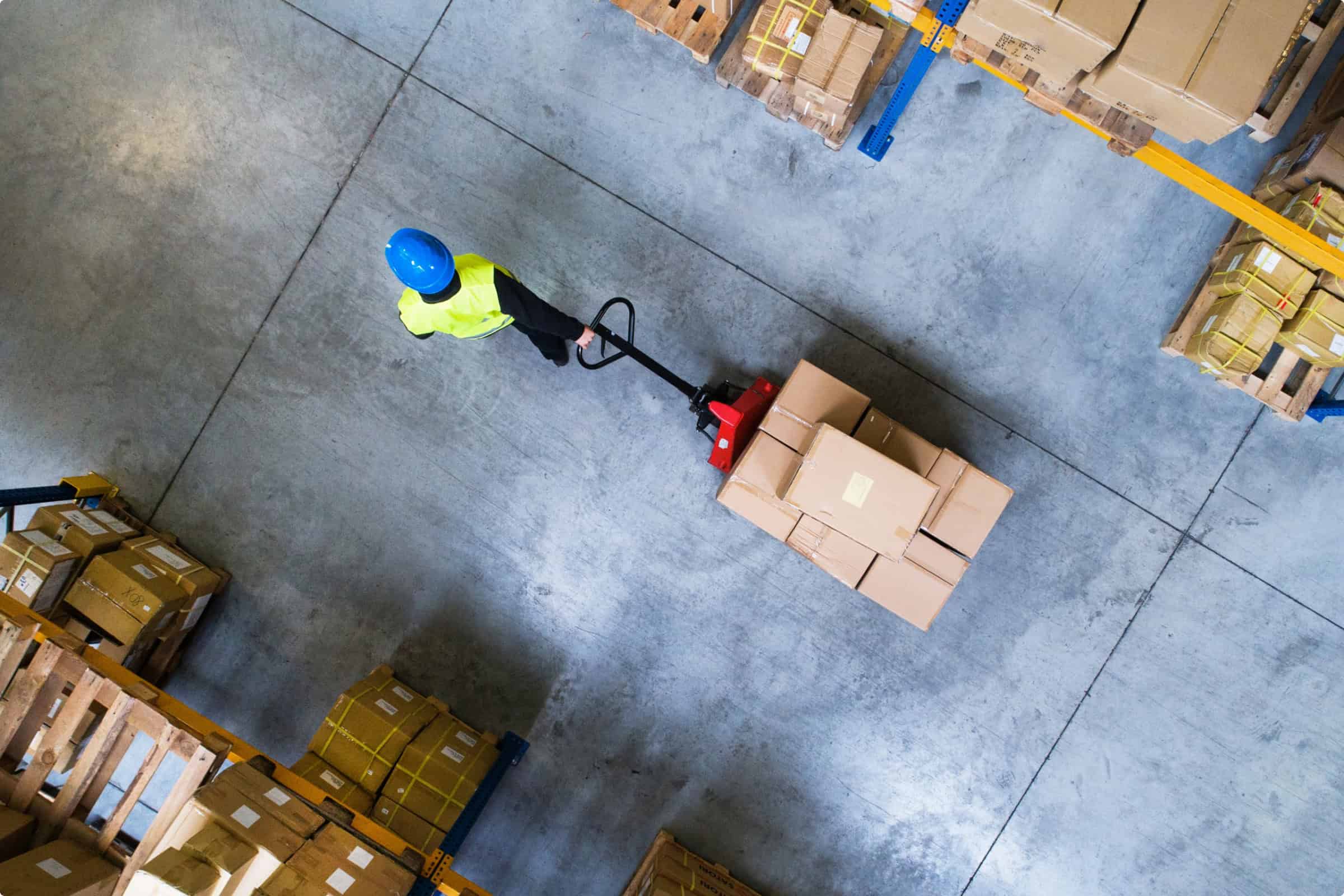
LTL freight is primarily moved by fork tines via a forklift and/or pallet jack at every stop in the network—origin, each transfer terminal, and destination. Each stop involves a minimum of three handling events: unloading the inbound trailer, moving across the dock, and reloading onto the outbound trailer. Additional handlings are likely as freight may sit on the dock waiting for its outbound trailer. The default assumption is that LTL freight will be handled by fork tines.
- Special handling expectations may be negotiated with your carrier.
- Notations added to the Bill of Lading at time of shipment such as ‘no fork tines’ or ‘hand load only’ are not binding on the carrier and do not guarantee special handling unless the service has been specifically quoted, agreed to, and confirmed during the quoting process prior to shipment.
- Fork tines via a forklift or pallet jack are used to move all freight types, including palletized loads, reels, wheeled or castered equipment, floor-loaded commodities, or loose freight.
- Heavy (75lb+) or awkward (long or large) non-palletized, floor loaded freight that cannot be easily lifted by hand may be scooped directly off the trailer floor or dock with fork tines.
- Many carriers utilize specialized fork tine attachments—such as fork extensions for long freight or grabbers for drums—to handle unique freight types.
Vibration
Vibration during transit is a constant force on every LTL shipment. Unlike shock events, which are short and extreme, vibration is low and continuous—the longer the route, the greater the cumulative exposure.
- Most LTL trailers use metal leaf spring suspension—air ride suspension, which significantly reduces vibration forces during transit, may not be standard and should be confirmed and/or negotiated with your carrier.
- Road surface quality varies across a typical LTL route—highways, urban streets, industrial areas, and dock approaches all generate different vibration intensities.
- Vibration causes freight to slowly work against its restraints—stretch film loses containment force, strapping loosens, and blocking and bracing can shift over time.
- Loose or poorly restrained components within a package act as battering rams under sustained vibration, damaging the product and packaging integrity from the inside.
- Vibration damage to packaging materials is cumulative and may not be visible until the packaging fails under an otherwise survivable load.
The effects from vibration are compounded by temperature and humidity exposure.
Vertical Shock
Shock events are short, extreme force events caused by road hazards and abrupt surface changes—including railroad crossings, potholes, bridge expansion joints, and speed bumps. Shock events are unavoidable during transit and should be expected on every LTL shipment. Unlike vibration which is continuous and low, shock is short and immediate—a single event can cause packaging or product failure.
- Most LTL trailers use metal leaf spring suspension—air ride suspension, which significantly reduces shock forces during transit, may not be standard and should be confirmed and/or negotiated with your carrier.
- Vertical shock forces in the LTL environment can exceed 3 times the force of gravity—a 100 pound package effectively becomes a 300 pound package for a fraction of a second.
- Top-loaded freight amplifies shock forces on lower packages—the heavier and higher the top load, the greater the impact.
- Corners and edges experience the highest stress concentration during a shock event and are the most likely failure points.
Horizontal Forces
Horizontal forces act on freight any time a truck changes speed or direction—acceleration, braking, and turning are unavoidable on every LTL shipment. Unlike vertical shock, which is brief and extreme, horizontal forces are moderate but recurring throughout the entire journey. In the LTL environment, horizontal forces regularly exceed 0.5 times the force of gravity—a 100 pound package has 50 pounds of lateral force pushing against it on every turn and stop.
- Special load securement expectations may be negotiated with your carrier.
- Freight that is only restrained in one direction—width but not length, or length but not width—will shift in the unrestrained direction under normal driving conditions.
- Braking and turning—at intersections, highway on-ramps, and merge point—are particularly dangerous for tall, top-heavy, or elevated freight; height increases instability, whether it comes from the freight itself, or its position in the trailer.
- Load shift brings freight into uncontrolled contact with adjacent loads, trailer walls, decking beams, and cargo straps—causing abrasion, puncture, or structural damage to packaging and/or product.
- Horizontal forces expose a fundamental LTL tradeoff—tightly loaded trailers reduce load shift but increase sustained abrasion pressure, while loosely loaded trailers reduce contact pressure but give freight room to accelerate into adjacent loads.
- Horizontal forces are cumulative across the journey—each braking and turning event works against stretch film containment force, strapping tension, and blocking and bracing integrity.
The effects from horizontal forces are compounded by temperature and humidity exposure.
Temperature, Humidity, and Pressure
A typical LTL shipment travels through multiple weather patterns, seasons, and climate zones before reaching its destination. The trailers carrying that freight are typically not climate controlled, and the docks where it is transferred are largely open to the outside environment. As a default assumption, freight will encounter ambient temperature, humidity, and air pressure changes throughout its journey—on the dock, in the trailer, and during every transfer in between.
- Special environmental expectations may be negotiated with your carrier.
Temperature
- Trailer interior temperatures on a single shipment can realistically swing 80°F or more—seasonal extremes across the network range from -40°F in winter to 160°F in summer, both of which degrade packaging materials, adhesives, and fastening methods.
Air Pressure
- LTL routes cross significant elevation changes and varied weather systems—the resulting pressure differentials can cause sealed containers, vacuum-sealed products, and pressurized packaging to deform, leak, or fail.
- Inflatable dunnage such as air pillows and void fill is particularly vulnerable—materials inflated at lower elevations may over-pressurize and burst at altitude.
Humidity & Moisture
- LTL docks are largely open to the outside—freight is potentially exposed to rain, snow melt, standing water, and ambient humidity at any given transfer.
- Concrete dock floors regularly develop condensation during early morning temperature swings, creating wet conditions that can saturate packaging and pallets in contact with the dock.
- Trailer interiors are generally not humidity controlled—humidity levels inside a trailer can be driven by the interaction between the trailer’s interior temperature and the outside environment. A cold trailer entering a warm humid environment can experience a rapid rise in interior humidity, potentially leading to condensation on walls, floors, and ceilings that can pool and saturate packaging and pallet bases.
- Pressure drops from elevation gain can cause relative humidity inside the trailer to rise.
- Many wood pallets are built from lumber that is still drying out—as the wood releases moisture during transit, interior trailer humidity can increase.
- Humidity alone can reduce corrugated stacking strength by more than 50%.
Trailer Loading
Trailer space utilization is a normal and necessary part of LTL operations — trailers would be approximately 50% empty if only the floor space was utilized. Utilization of the upper space in the trailer keeps shipping costs low and the network efficient. Generally, carriers utilize three methods to load freight in the upper space of a trailer: decking tables, decking beams, and direct stacking.
- Special loading expectations may be negotiated with your carrier.
- Specific loading conditions beyond standard practice are only guaranteed when negotiated, confirmed, and paid for as part of the service agreement—without that agreement, shippers have no control over what is loaded above, beside, or around their freight.
- Generally, dock workers are evaluated on speed and efficiency and must make trailer loading decisions rapidly right on the dock floor based on several factors:
- Immediate availability of freight;
- Individual pallet weights;
- A visual assessment of what packaging appears capable of supporting;
- Contractual loading obligations; and
- Availability and benefit of decking beams or tables.
- The location of freight within a trailer may change at every service center stop—freight on the floor at origin may be on a decking beam or table during linehaul.
Decking Table: is a freestanding, heavy-duty steel frame or platform with its own integrated legs that sits directly on the trailer floor. Typically, it is about 48in tall with a semi-solid top surface. It is placed over a bottom row of freight to act as a sturdy, self-supported shelf, allowing a second tier of pallets to be loaded on top without putting any weight on the cargo below.
- Freight must be secured to prevent it from sliding on or off the table. This may include cargo straps, load beams, chocking, and/or adjacent freight.
- The horizontal edges of the tables or any overhanging pallets can create a contact hazard for taller, adjacent freight.
Decking Beam: is a heavy-duty, adjustable metal bar designed to snap securely into the vertical or horizontal logistics tracks in an LTL trailer. By snapping multiple beams into the tracks side-by-side at the same level, dock workers can create a sturdy, elevated loading surface at any height within the trailer. This setup allows a second or third layer of palletized freight to ride safely above lower cargo without putting any weight on the cargo below.
- A trailer loader uses the certified weight capacity stamped on each decking beam to deploy the exact number needed to safely support upper-tier freight; however, because large or long lightweight cargo may only require two beams for weight support, the packaging or product itself can easily sag, bend, or fail during transit due to lack of center support.
- Freight must be secured to prevent it from sliding on or off the decking beams. This may include cargo straps, load beams, chocking, and/or adjacent freight.
- The decking beams and pallets on the decking beams can create a contact hazard for taller, adjacent freight.
Direct Stacking: freight placed directly on top of other freight—is often, but not always, the default trailer loading method. Packaging that is not designed for anticipated top-road forces is one of the most common and preventable sources of LTL freight damage.
- The average cubic density of LTL freight is approximately 12 lbs/ft³—the space above a large flat shipment can represent thousands of pounds of potential top load.
- Requesting that freight not be stacked—in any form, whether on the BOL, on the packaging, or through physical indicators—does not guarantee special handling unless the service has been specifically quoted, agreed to, and confirmed during the quoting process prior to shipment.
- Top load forces are compounded by shock, vibration, temperature, and humidity—a static top load becomes a dynamic and variable force from the moment the trailer leaves the dock.