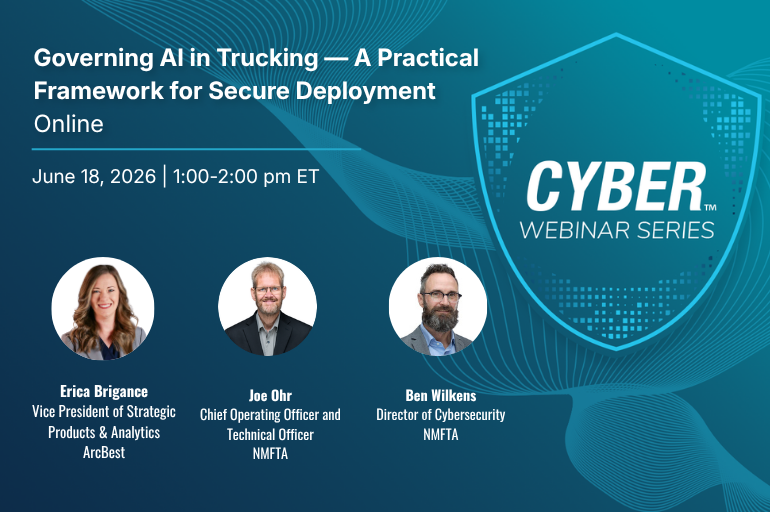
Attendees joined us on Thursday, June 18, 2026, at 1:00 pm ET, as Erica Brigance and the National Motor Freight Traffic Association, Inc.® (NMFTA)® cybersecurity team discussed Governing AI in Trucking — A Practical Framework for Secure Deployment.
Watch the recording below.
Description
AI-enabled tools have rapidly transformed trucking operations, from dispatch and routing to safety monitoring and back-office automation. However, the speed of adoption has outpaced many fleets’ ability to evaluate how these systems use their data, who is accountable when something goes wrong, and how to distinguish a credible AI vendor from a wrapper around someone else’s model. Without a clear governance strategy, motor carriers have often been left negotiating AI risk, accountability, and compliance one contract at a time.
This webinar introduced the upcoming NMFTA AI Governance Framework, a practical resource designed to help trucking organizations deploy AI securely, responsibly, and efficiently.
Attendees explored the controls outlined in the framework, gained an understanding of how they align with recognized standards including AIUC-1, ISO 42001, and the NIST AI Risk Management Framework, and learned how those controls translate into trucking-specific guidance fleets can apply regardless of size or cybersecurity maturity.
Built for IT leaders, cybersecurity practitioners, and operations executives, this session provided actionable insight into governing AI adoption without slowing business operations or innovation.
Learning Outcomes
Attendees learned how to:
- Identify the key governance and security risks associated with AI-enabled trucking technologies.
- Evaluate AI vendors and understand accountability considerations tied to third-party AI models.
- Apply practical AI governance controls within fleet and logistics environments.
- Map AI governance activities to frameworks including AIUC-1, ISO 42001, and the NIST AI Risk Management Framework.
- Translate technical AI governance concepts into operational policies and procedures fleets can implement.
- Build a scalable approach to AI oversight that balances innovation, security, and operational efficiency.
Meet The Speakers

Erica Brigance is the Vice President of Strategic Products & Analytics at ArcBest. In this role, she leads the organization’s product management, analytics, and AI strategies—delivering value through strategic initiatives, helping answer important questions, and structuring unstructured data through machine learning and generative AI.
With over 20 years of transportation and logistics experience at ArcBest, Erica has played an integral role in implementing digital platforms and transformative technologies that solve customers’ complex supply chain challenges. Some of her recent work includes involvement in the company’s City Route Optimization technology, which employs artificial intelligence and historical data to streamline shipment routing and ensure trucks are filled to optimal capacity, and the implementation of Generative AI tools that augment the work of our talented people.
Erica holds an Executive MBA from the University of Arkansas and was selected as a 2022 Women in Supply Chain Award winner by Supply & Demand Chain Executive.

Joe Ohr has more than two decades of experience in technical operations, customer success management, IT, customer support, and product support.
Currently serving as the Chief Operations and Technical Officer for the National Motor Freight Traffic Association, Inc.® (NMFTA)®, he plays a pivotal role in helping to advance the industry through digitization, classification, and cybersecurity.
Prior to Ohr’s role at NMFTA, he served as in numerous IT, engineering, and operations positions at Qualcomm and Eaton, and most recently held the position of Senior Vice President of Operations/Customer Experience at Omnitracs.

Ben Wilkens, CISSP, CCSP, CISM, is the Director of Cybersecurity at the NMFTA.
In his role at NMFTA, Ben spearheads research initiatives and leads teams dedicated to developing cutting-edge cybersecurity technologies, methodologies, and strategies to safeguard information systems and networks. He collaborates extensively with academic institutions, industry partners, and government agencies to advance cybersecurity practices and knowledge.
Ben provides expert insights and recommendations to organizations, enhancing their security posture and helping them navigate the constantly evolving landscape of cyber threats.